The 10 Best Photo Spots in Montmartre Paris, and When the Light Works
The short answer
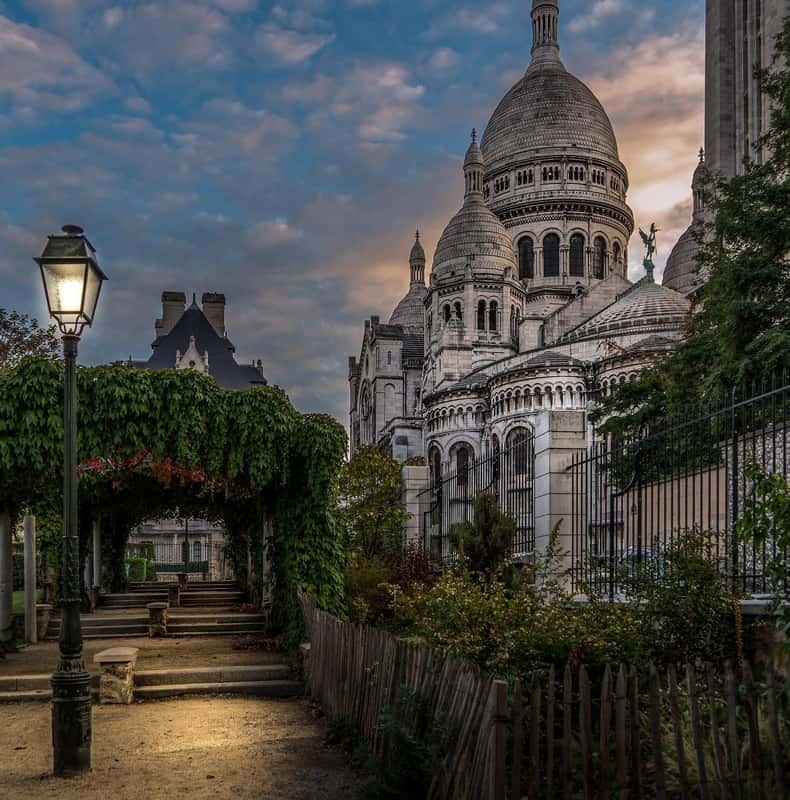
Montmartre faces south, so the basilica wants the afternoon and the north-slope lanes want the evening. Rue de l’Abreuvoir and Place du Tertre want to be empty, which means before nine. Le Mur des Je t’aime wants an overcast sky.
Light first, location second
Montmartre faces south, and that single fact decides most of this list. The basilica takes the sun on its front all afternoon and is flat and grey at dawn. The lanes on the north slope are in shade until late morning and glow in the evening. And the hour that matters moves five hours across the year: sunset runs from 4.55pm on 21 December to 9.57pm on 21 June. The weather page has the month-by-month figures.
The ten, with the hour each one wants
| # | Spot | Best hour | Why |
|---|---|---|---|
| 1 | Square Louise-Michel, looking up | Late afternoon | Sun on the west front, city behind you |
| 2 | The parvis, looking out | Golden hour | The whole city, and the only free 130-metre viewpoint |
| 3 | Rue de l’Abreuvoir | Before 9am | Empty cobbles, La Maison Rose at the end |
| 4 | La Maison Rose | Before 9am | The queue for this corner starts at ten |
| 5 | Clos Montmartre, rue des Saules | October | The vine leaves turn and the basilica sits above them |
| 6 | Place du Tertre | 7–9am | Painters setting up, nobody else there |
| 7 | Le Mur des Je t’aime | Overcast midday | Flat light stops the enamel blowing out |
| 8 | Rue Foyatier, the stepped street | Blue hour | Lamps, steps and the lit basilica in one frame |
| 9 | Moulin de la Galette | Late afternoon | The sails catch the low sun |
| 10 | Moulin Rouge | After dark | The sign is the picture, and it needs night |
The two that need an early alarm
Rue de l’Abreuvoir and Place du Tertre are transformed by being empty, and both fill by mid-morning every day from April to September. There is one guided walk on this hill that exists purely to be up there at dawn, with breakfast afterwards, and it is the easiest way to make yourself do it.
The one that needs bad weather
Le Mur des Je t’aime is enamelled lava, and in direct sun the dark blue tiles blow out and the white lettering disappears. An overcast day is the right day for it.
The one that needs the right month
The vineyard on rue des Saules is a set of bare railings for most of the year and a photograph in October, when the leaves turn and the Fête des Vendanges fills the street below it. In 2026 that runs from 7 to 11 October.
What the seasons do to this list
Four of the ten change completely across the year, and it is worth knowing which before you plan a trip round them.
Winter gives you the shortest queues and the earliest golden hour. In late December the sun is down by 4.55pm, so the blue-hour shot on rue Foyatier is one you can take before dinner rather than at ten at night. The trade is 57 hours of sunshine in the whole month, so you may be waiting for a gap.
Spring is the best all-round compromise. April brings 177 hours of sun and a sunset around 8.40pm, with wisteria on several of the lanes. The coach crowds have not fully returned.
Summer is the hardest month to photograph the hill well. The light is excellent and the square is full from ten in the morning until seven at night, so everything on this list except the Moulin Rouge wants an early start.
Autumn is when the vineyard works. The leaves on rue des Saules turn through October and the Fête des Vendanges fills the street below from 7 to 11 October 2026. The low sun also angles down the north-slope lanes as it does at no other time of year.
Two frames almost nobody takes
Looking back down rue Foyatier from halfway up. Everyone photographs the steps from the bottom. From the sixth landing the funicular, the steps and the rooftops stack into one frame, and there is nobody standing in it.
The apse from rue du Chevalier de la Barre. The front of the basilica is the shot everybody already has. From behind and below, the domes and the half-round of the apse pile up above you, and in the afternoon the stone is lit rather than flat.
Where to stand, practically
- Come in at Abbesses, not Anvers, if the light is going. It puts you on the west side, which is where the evening sun is.
- Use the funicular going up and walk down. You will see more, and you will not be out of breath at the viewpoint.
- Respect the pedestrian zone. Fifteen streets on the upper Butte are now pedestrian-priority; there is no traffic to dodge, and no reason to stand in the road.
- Look behind you on every staircase. The best frames on this hill are almost all backwards.
The map page shows where each of these sits, and the gallery is most of this list already photographed.
Two frames that depend on somebody else
The Moulin de la Galette is private property photographed from a public street, and the angle that works is from rue Lepic looking up rather than from the restaurant terrace below it. The Clos Montmartre is behind railings, so the frame is always through them — which is why October, when the leaves are up against the bars, is the month it works.
The kit question, briefly
Montmartre is a wide-angle hill and a long-lens hill, and very little in between. The lanes are narrow enough that a wide lens is the only way to get a street and its rooftops into one frame, and the view from the parvis wants length to pull the Panthéon and the Tour Montparnasse out of the haze. A phone handles eight of the ten spots above perfectly well; the two it struggles with are the blue-hour frame on rue Foyatier, which wants something to rest the camera on, and the interior of the basilica, where the light is low and tripods are not welcome.
Whatever you carry, carry less of it than you think. This is a hill with 222 steps in it and a lot of the good frames are found by wandering rather than by setting up.
What a guide adds to a photo walk
Route knowledge, mostly. A guide knows which lane is in shade at four o’clock and which staircase gives you the domes above the rooftops, and on a hill with no signposted route that is worth more than a tripod. Best Montmartre walking tours start at $23, and the landmarks page tells you what you are looking at when you get there.
Set an alarm for the two that need it, and let the weather decide the rest. The walks built round the light are all on Montmartre Paris Tours.
Walks built round the light
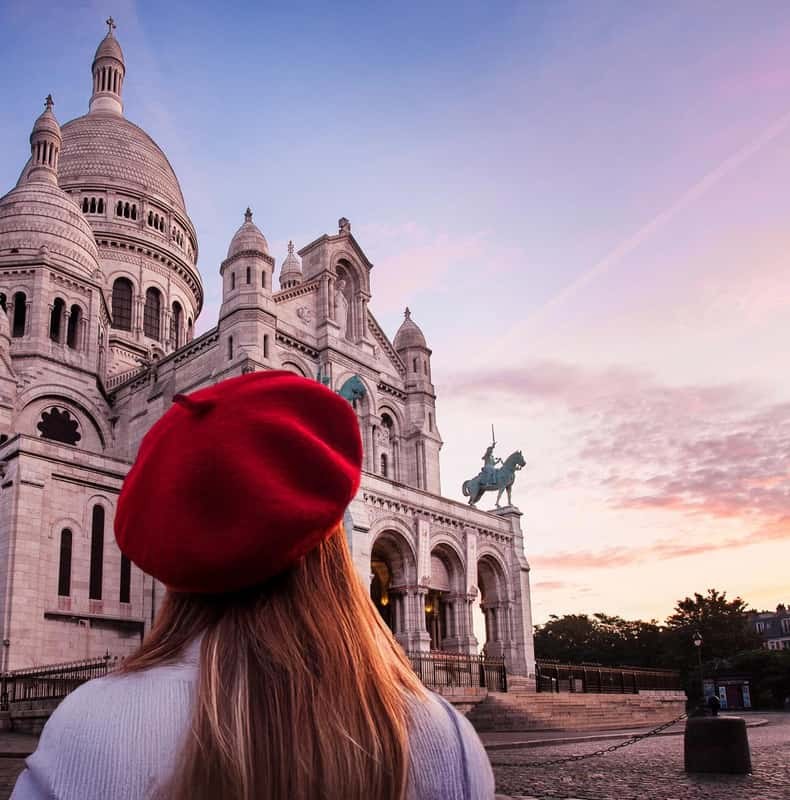
Montmartre Before the Crowds: Walk Tour & Breakfast
A dawn departure from Anvers with breakfast at the end — the only reliable way to photograph Place du Tertre without anyone in it.
From $68 per person
Check Availability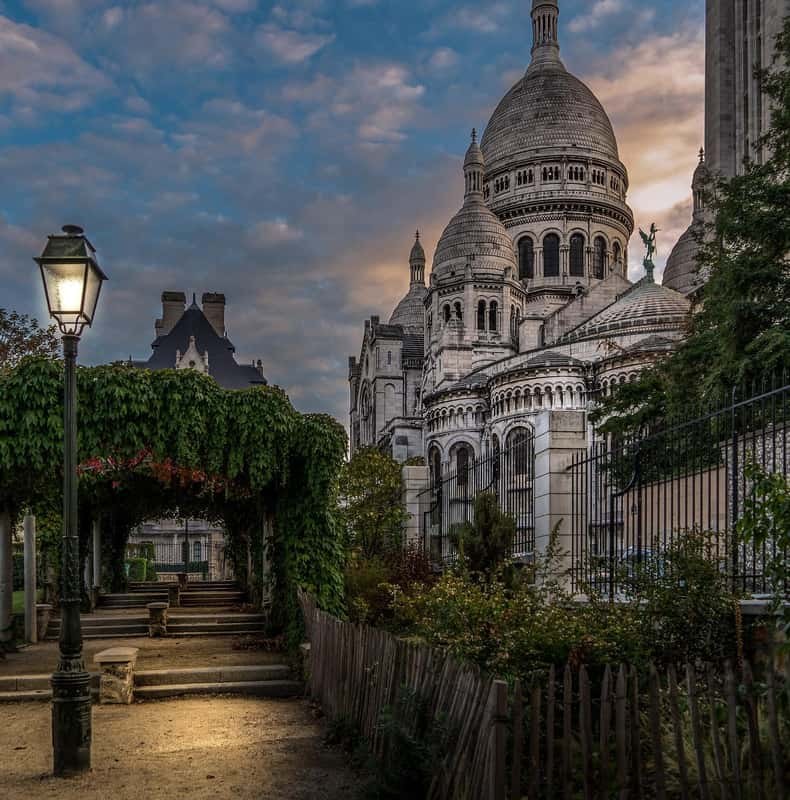
Paris: Montmartre Highlights Walking Tour with a Local Guide
Two hours twenty that stop rather than pass, with real time at the Wall of Love, the Bateau-Lavoir and La Maison Rose.
From $27 per person
Check Availability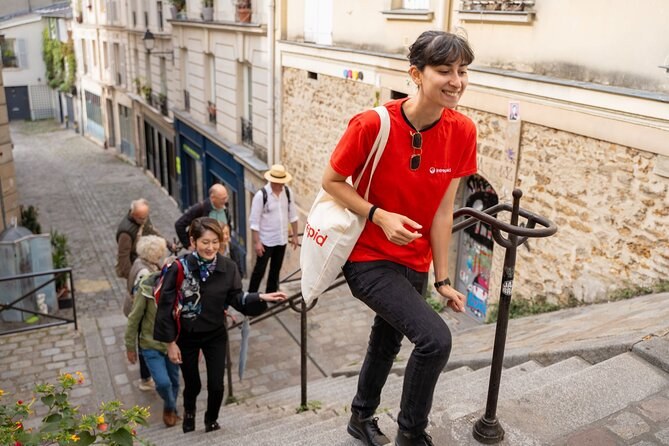
Paris Montmartre Walking Tour: Hidden Gems, Views & Croissant
Built around the viewpoints local people use rather than the signposted ones, up the back stairways from Place Blanche.
From $41 per person
Check Availability