14 Surprising Facts About Montmartre Paris
The short answer
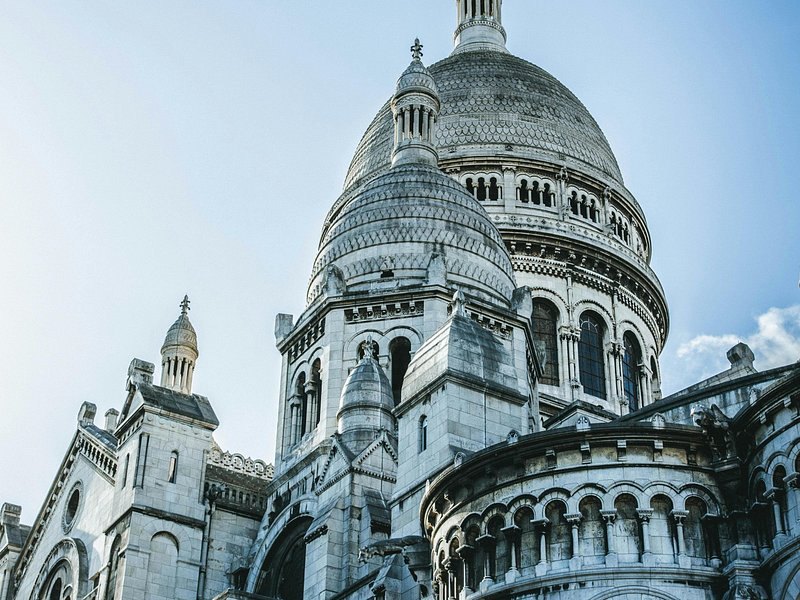
The hill is hollow, the basilica stands on eighty-odd shafts sunk through old quarries, its bell weighs 19 tonnes, and there is a working vineyard in the middle of it that was planted in 1933 to stop the plot being built over.
Fourteen things about this hill that surprise people
Every one below is published by the basilica, the City of Paris, the wall’s own site or the museums themselves, and checked on 2026-09-08. The full reference set, with the source against each figure, is on the facts page.
1. The hill is hollow
Montmartre was quarried for gypsum on such a scale that the ground under parts of the village is a honeycomb. Plaster of Paris is named after it. Quarrying was stopped in the nineteenth century because the hill was becoming unsafe.
2. The basilica stands on eighty-odd stilts
Because of the quarrying, the Sacré-Cœur could not simply be founded on the ground. Deep shafts were sunk through the worked rock to reach something solid, and the building sits on those.
3. It took more than forty years to build
First stone in 1875, solemn inauguration in 1891 with the dome unfinished, campanile completed on 6 April 1912, and consecration only on 16 October 1919, after the First World War. Four decades and a war.
4. Somebody has been praying in it continuously since 1885
Perpetual adoration began on 1 August 1885 and has not been interrupted since. That is why the doors open at 6.30am and do not close until 10.30pm.
5. Its bell weighs 19 tonnes
La Savoyarde was cast in 1891 and installed on 20 November 1895. It is the largest bell in France and one of the largest swinging bells anywhere.
6. There is a working vineyard in the middle of it
The Clos Montmartre on rue des Saules holds 2,000 vines and took its first harvest in 1934, with Mistinguett and Fernandel presiding. It was planted to stop the plot being built over.
7. The hill once had thirty windmills
Two are left: the Blute-Fin and the Radet, together the Moulin de la Galette. They ground flour and pressed grapes before they became a dance garden and a Renoir.
8. The Paris Commune started here, on a Saturday morning
The National Guard’s cannons were parked on the Butte after the siege of 1870. On 18 March 1871 the government sent troops to take them back, the crowd stopped them, two generals were shot, and the Commune began. The history page follows what happened next.
9. The wall of love is made of lava
Le Mur des Je t’aime is 612 tiles of enamelled lava, each 21 by 29.7 centimetres, covering 40 square metres. Frédéric Baron collected the phrases by knocking on embassy doors.
10. The highest natural point in Paris is 130 metres
That is the Butte, and it is why the view works: you are looking at the city from ground that was here before any of it. Everything taller in Paris is a building, and every one of them is below you when you stand on the parvis.
11. There are 222 steps — and 280 more inside
222 from Square Louise-Michel to the parvis, then 280 up a narrow spiral staircase to the dome, with no lift. The funicular exists for the first number; nothing helps with the second.
12. Twenty thousand people are buried under the road bridge
Montmartre Cemetery sits in a former quarry, and rue Caulaincourt was built straight over it on an iron bridge. More than 20,000 graves are underneath.
13. The largest private Dalí collection in France is in a cellar
Dalí Paris holds more than 300 works at 11 rue Poulbot, in the old quarry cellars a minute from Place du Tertre.
14. The Tour de France now finishes over the top of it
In July 2026, for the second year running, the final stage routed over the Butte, with the riders climbing rue Lepic three times before the finish on the Champs-Élysées.
The numbers, in one place
If you want to check any of these before you repeat them, here they are with the body that publishes each one.
| Fact | Figure | Published by |
|---|---|---|
| Height of the Butte | 130 m | Ville de Paris |
| Steps to the parvis | 222 | Ville de Paris |
| Steps inside the dome | 280 | Sacré-Cœur |
| La Savoyarde | 19 tonnes, installed 1895 | Sacré-Cœur |
| Apse mosaic | 480 m², 1923 | Sacré-Cœur |
| Clos Montmartre | 2,000 vines, first harvest 1934 | Ville de Paris |
| Le Mur des Je t’aime | 612 tiles, 40 m² | lesjetaime.com |
| Montmartre Cemetery | more than 20,000 graves | Ville de Paris |
Which of these you can actually see
Most of them. You can stand under the bell tower, though you cannot see La Savoyarde itself; you can look at the mosaic for as long as you like for nothing; you can put your hand on the railings of the vineyard and read the plaque. What you cannot see is the part that holds the whole thing up — the shafts under the basilica, and the quarry galleries under the streets you are standing on. If you want the rest of the story behind these, the history page runs it in order and the landmarks page tells you where each one is.
Where these come from
Nothing above is folklore. The construction dates, the bell and the perpetual adoration are the basilica’s own record; the vineyard, the cemetery and the height of the Butte are the City of Paris; the wall’s dimensions are from the wall’s own site. Two official pages disagree on the number of vines, and the facts page says so rather than picking the tidier figure.
Most of these come up on the ground, which is what Guided tours of Montmartre are for — and the landmarks page tells you where each one is.
Fourteen facts, one hill, and every one of them published by somebody who should know. If you would rather hear them on the ground, Montmartre Paris Tours lists every guided walk on the Butte.
Walks where these come up on the ground

Montmartre Street Art Tour with an Artist
Two hours and a quarter of walls with a working street artist — the layer of this hill's history that is still being added to.
From $49 per person
Check Availability
Montmartre District and Sacre Coeur - Exclusive Guided Walking Tour
A private guide for two and a half hours, in any of six languages, with time to actually ask where the quarries went and what the cannons were doing here.
From $65 per person
Check Availability
Montmartre for Art Lovers - Walking tour with Expert Guide
Starts inside Montmartre Cemetery, whose entry is in the fare, and turns the history into trivia questions with a prize at the end.
From $23 per person
Check Availability